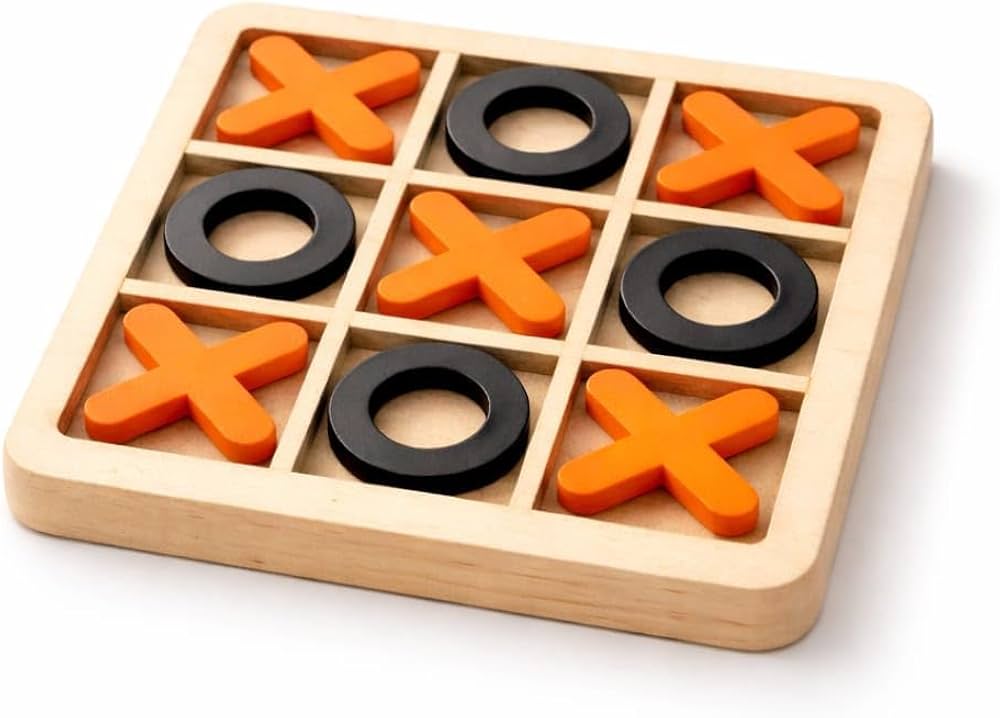
If you’ve played tic tac toe against a friend who knows what they’re doing, you know how it goes. Game after game ends with a full board and no winner. At some point, everyone asks the same question: can anyone actually win this game?
The short answer: yes, tic tac toe always ends in a draw when both players play perfectly. Mathematicians call it a solved game: every possible move has been analyzed, and with best play from both sides, neither player can force a win. The catch is that most people don’t play perfectly, and that’s where wins come from.
Here’s the math behind those nine squares, the exact strategy that never loses, and how to take advantage of an opponent who makes one small mistake.
Tic tac toe looks tiny, but there are more possible games than you might guess. If you count every possible sequence of moves until someone wins or the board fills up, there are 255,168 different games. Here’s how they end:
| Result | Number of games | Share |
|---|---|---|
| X (first player) wins | 131,184 | about 51% |
| O (second player) wins | 77,904 | about 31% |
| Draw | 46,080 | about 18% |
| Total | 255,168 |
Notice something strange? Only about 18% of all possible games end in a draw. If both players moved at random, X would win more than half the time.
So why does every serious game end in a tie? Because good players never play random moves. Most of those 255,168 games include at least one blunder: a missed block or an ignored threat. Take out the mistakes, and all that’s left is a draw.
If you treat rotated and mirrored boards as the same, the game shrinks a lot: only 765 essentially different positions and 138 different final boards. That’s small enough for people to have worked out every line by hand, long before computers.
Two things make tic tac toe a guaranteed draw.
Every threat can be blocked. When your opponent has two in a row, you simply place your mark in the third square. On a 3×3 board, a single threat is always easy to see and stop.
The only way to win is a fork, and forks can be prevented. A fork is when you create two threats at once. Your opponent can block one, but not both. Forks are the only way to beat a careful player, and a careful player always makes the move that stops a fork from forming.
When both players block every threat and prevent every fork, the board fills up with no winner. Every time.
In 1972, computer scientists Allen Newell and Herbert Simon described a simple priority list for playing tic tac toe. On each turn, use the first rule that applies:
Follow this list carefully and you’ll never lose a game. Against an equally careful opponent, you’ll never win one either.
To make this easier to follow, number the squares like a phone keypad:
1 | 2 | 3 ----------- 4 | 5 | 6 ----------- 7 | 8 | 9
As X (going first): a corner, the center and an edge can all lead to a draw with perfect play, so none of them loses outright. The corner is the trickiest for your opponent, because it leaves O the fewest safe replies.
As O (going second), your reply depends on X’s first move:
| X opens with… | O’s safe reply |
|---|---|
| A corner | The center, and nothing else |
| The center | A corner |
| An edge | The center, a corner next to X, or the opposite edge |
The first row of that table matters most. When X takes a corner, every reply except the center loses against good play. Most casual players don’t know this, and that’s your opening.
Here’s the corner trap in action. You’re X.
Example 1: O replies on an edge.
Example 2: O replies in the opposite corner.
In both games, O made one wrong move on turn one, and the rest was forced. That’s the real secret of tic tac toe. You don’t beat good players. You beat players who don’t know the corner rule.
When you’re O, flip it around: answer a corner with the center, and you’re safe.
Three-in-a-row games are surprisingly old. Boards like this appear on Egyptian roofing tiles from around 1300 BC. In ancient Rome, people played a game called terni lapilli, where each player had only three pieces and had to move them around the board, and grids for it have been found scratched into stone around the city.
The name “noughts and crosses” appeared in print in Britain in 1858, while “tick-tack-toe” shows up in 1884, and the American spelling “tic-tac-toe” came later.
The game also has a special place in computing history:
If perfect play always ends in a draw, is there any point in playing? Yes, for a few good reasons.
For children, tic tac toe is often their first strategy game. It teaches them to look one move ahead, check for threats, and notice that the opponent has a plan too. That’s a lot of thinking packed into 30 seconds.
For adults, the fun is in the trap. Setting up a fork against someone who doesn’t see it coming is still satisfying, even when you know the math.
And for anyone who thinks they’ve mastered it, there’s always a bigger board. Larger and 3D versions of the game get much harder. A 4×4×4 version called Qubic wasn’t solved until 1980, when it was proven to be a first-player win.
The best way to learn the corner trap is to try it. You can play free tic tac toe in your browser at Online Timepass Games, against a smart AI or in two-player mode with a friend on the same screen. Open with a corner, see if the AI takes the center, and then try to hold it to a draw as O. No download or sign-up needed.
7. FAQs
Is tic tac toe always a draw?
Only when both players play perfectly. Tic tac toe is a solved game: with best play from both sides, it always ends in a draw. Most real games are decided by a single mistake.
What is the best first move in tic tac toe?
A corner. It doesn’t guarantee a win, but it gives your opponent the fewest safe replies. Only the center is safe for O after a corner opening.
Can the second player ever win tic tac toe?
Yes, but only if the first player makes a mistake. Against perfect play, O’s best result is a draw.
How many possible games of tic tac toe are there?
255,168, if you count every sequence of moves until the game ends. If you treat rotated and mirrored boards as the same, there are 765 essentially different positions.
What is a fork in tic tac toe?
A move that creates two winning threats at once. Your opponent can only block one of them, so a fork wins the game. Preventing your opponent’s forks is the key to never losing.

This post has been authored and published by one of our premium contributors, who are experts in their fields. They bring high-quality, well-researched content that adds significant value to our platform.












HD Hub Movies is your trusted source for movie news, entertainment updates, streaming guides, celebrity stories, and informative content.